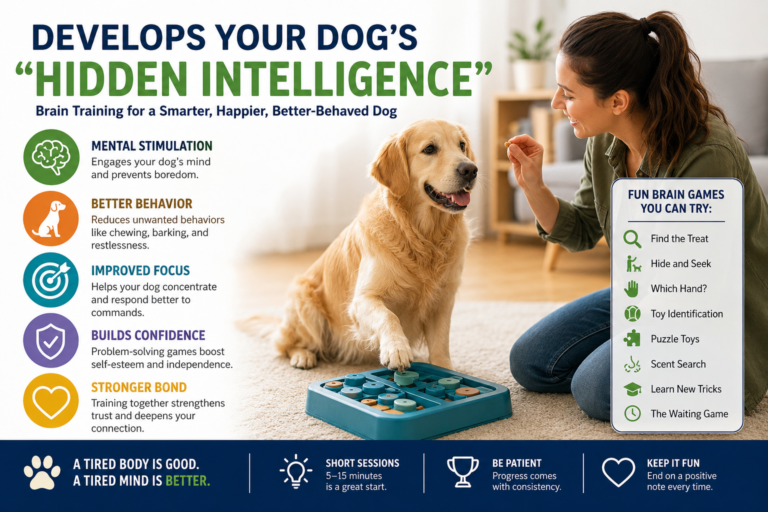
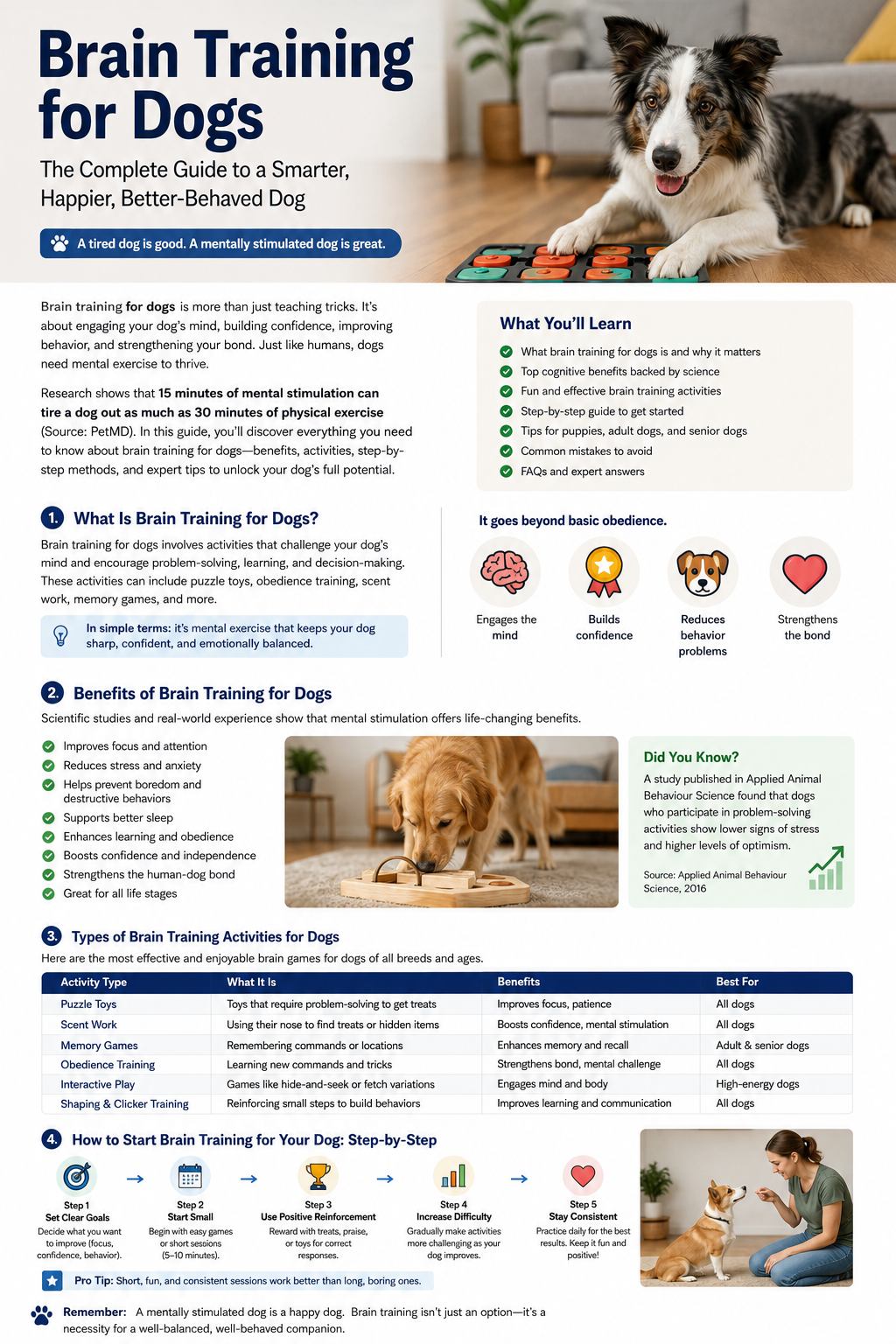
A tired dog is not always a satisfied dog. Your pet can enjoy a long walk and still come home looking for something to do. That’s because dogs need mental stimulation as well as physical exercise.Brain Training for Dogs involves activities that encourage dogs to think, learn, remember, solve simple problems, and make good choices. These activities can include obedience training, scent games, puzzle toys, trick training, target exercises, and interactive games.
The good news is that you don’t need expensive equipment to begin. Many effective brain games can be practiced at home using treats, toys, household objects, and positive reinforcement.

What You’ll Learn
In this guide, you’ll learn:
- What brain training for dogs means
- Why mental stimulation is important
- The benefits of cognitive exercises
- 10 brain games you can try at home
- How to start a training routine
- How positive reinforcement works
- Brain training tips for puppies and senior dogs
- Common training mistakes
- When professional help may be necessary
- How online dog-training programs compare with DIY training
What Is Brain Training for Dogs?
Brain training for dogs is a form of mental exercise that encourages a dog to learn behaviors, solve problems, use its senses, remember information, and respond to cues.
Unlike ordinary physical exercise, brain training focuses on how a dog processes information.
Examples include:
- Learning new commands
- Finding hidden treats
- Identifying toys
- Following scent trails
- Solving food puzzles
- Learning tricks
- Practicing impulse control
- Target training
- Hide-and-seek
- Object discrimination
Mental enrichment can be especially useful for dogs that become bored when their daily routine does not provide enough opportunities to explore, learn, and interact.
Why Is Mental Stimulation Important for Dogs?
Dogs naturally spend time exploring their surroundings, sniffing, watching, searching, and interacting.
A highly repetitive routine may not provide enough mental variety.
Brain games give your dog a constructive activity.
For example, instead of simply placing your dog’s food in a bowl, you can occasionally use part of the normal meal for a supervised food-search game.
This changes eating from a simple physical action into an opportunity to sniff and problem-solve.
The American Veterinary Society of Animal Behavior recommends reward-based training and emphasizes humane, evidence-based methods for teaching dogs.
Benefits of Brain Training for Dogs
1. Improves Focus and Attention
Training teaches dogs to pay attention to a cue and respond appropriately.
For example, teaching your dog to look at you when you say its name can become a foundation for other behaviors.
2. Helps Reduce Boredom
Bored dogs may find their own entertainment.
That could include chewing, digging, barking, stealing objects, or repeatedly demanding attention.
Mental games provide a more appropriate outlet.
3. Builds Communication
Training creates a simple communication system between you and your dog.
Your dog learns what certain words or signals mean, while you learn how to communicate more clearly.
4. Encourages Problem Solving
Puzzle games allow dogs to work out simple challenges.
Start with easy tasks and gradually increase the difficulty.
5. Supports Confidence
Successful training experiences can give a dog more opportunities to make correct choices and receive rewards.
Avoid making exercises unnecessarily difficult. A dog that repeatedly fails can become frustrated rather than engaged.
6. Strengthens the Human-Dog Bond
Training is not just about obedience.
It creates time for you and your dog to work together.
Reward-based training can also support a positive relationship between dogs and their owners. AVSAB’s current guidance recommends reward-based methods and advises against aversive training methods.
10 Brain Training Games for Dogs
1. Find the Treat
Place a small amount of your dog’s normal food somewhere easy to find.
Let your dog search for it.
Once your dog understands the game, gradually make the hiding places more challenging.
2. Hide and Seek
Ask your dog to stay with another person while you hide somewhere nearby.
Call your dog.
When your dog finds you, reward it with praise, food, or play.
3. The Name Game
Place a toy in front of your dog.
Say the toy’s name and reward your dog for interacting with it.
Once your dog understands one object, introduce another.
4. Target Training
Teach your dog to touch your hand with its nose.
Reward the behavior immediately.
Target training can later become useful for teaching more complex behaviors.
5. Food Puzzle Games
Use an appropriate food puzzle that requires your dog to work for part of its meal.
Always choose a puzzle suitable for your dog’s size and chewing style.
6. Toy Cleanup
Teach your dog to pick up a toy and drop it into a basket.
Break the behavior into small steps.
First reward picking up the toy. Then reward moving toward the basket. Finally, reward dropping the toy inside.
7. Shell Game
Place a treat underneath one of several safe cups.
Move the cups slowly.
Encourage your dog to find the correct one.
8. Scent Search
Hide a favorite toy or a small amount of food.
Encourage your dog to use its nose to find it.
Scent-based games are especially useful because they allow dogs to use one of their most important natural senses.
9. Learn a New Trick
Try teaching:
- Spin
- Touch
- Wave
- Bow
- Place
- Take it
- Drop it
- Roll over
Keep sessions short and reward successful attempts.
10. Impulse-Control Games
Ask your dog to wait briefly before receiving a toy, meal, or access to a desired activity.
Gradually increase the waiting period.
The goal is to teach calm behavior, not to frustrate the dog.
How to Start Brain Training for Dogs
You don’t need a complicated routine.
Follow these five steps.
Step 1: Start With an Easy Task
Choose something your dog can accomplish quickly.
Early success builds engagement.
Step 2: Choose a Reward
Rewards can include:
- Small treats
- Normal kibble
- Toys
- Praise
- Play
- Access to something your dog enjoys
The best reward depends on the individual dog.
Step 3: Mark the Correct Behavior
Use a consistent word such as “yes” or a clicker when your dog performs the desired behavior.
Then provide the reward.
Step 4: Increase Difficulty Slowly
Don’t move from an easy living-room exercise directly into a distracting environment.
Progress gradually:
Easy → Moderate → Distracting → Real-world
Step 5: Finish on a Success
If your dog is becoming tired, distracted, or frustrated, stop.
Training should remain enjoyable.
Positive Reinforcement and Brain Training
Positive reinforcement means increasing a desired behavior by following it with something the dog values.
A simple example is:
Cue → Desired behavior → Marker → Reward
For example:
“Sit” → Dog sits → “Yes!” → Treat
With repetition, the dog learns that sitting after the cue produces a rewarding outcome.
AVSAB states that current evidence supports reward-based training for canine training and behavior modification. It also advises against methods based on pain, fear, or physical discomfort.
This makes reward-based learning an important part of responsible brain training.
Brain Training for Puppies
Puppies are constantly learning about the world.
Simple mental exercises can help them learn useful behaviors while keeping sessions engaging.
Good puppy activities include:
- Name recognition
- Hand targeting
- Simple recalls
- Finding food
- Basic sit and down
- Gentle handling exercises
- Short impulse-control games
- Safe exploration
Keep sessions short.
Puppies have limited attention spans, and training should be appropriate for their age and physical development.
Brain Training for Adult Dogs
Adult dogs can handle increasingly complex exercises.
You can combine multiple skills.
For example:
Sit → Stay → Find toy → Bring toy → Drop toy
This creates a short chain of behaviors.
Adult dogs can also benefit from:
- Scent work
- Advanced tricks
- Object recognition
- Food puzzles
- Recall practice
- Impulse control
- Obedience exercises
Brain Training for Senior Dogs
Older dogs can continue learning.
However, activities should take their physical condition into account.
Good options include:
- Scent games
- Easy food puzzles
- Recognition games
- Gentle targeting
- Calm obedience
- Simple trick training
Avoid exercises that require unnecessary jumping or strenuous movement.
If an older dog’s behavior changes suddenly, consult a veterinarian rather than assuming the change is simply caused by aging.
Brain Training vs Physical Exercise
Brain training should complement physical activity, not replace it.
| Activity | Main Purpose |
|---|---|
| Walking | Physical activity and environmental exploration |
| Running | Cardiovascular exercise |
| Scent games | Mental stimulation |
| Obedience training | Learning and communication |
| Puzzle toys | Problem solving |
| Trick training | Learning and engagement |
| Interactive play | Physical and mental activity |
A healthy routine can combine several of these activities.
Common Brain-Training Mistakes
Making Exercises Too Difficult
If your dog cannot solve the problem, make it easier.
Training for Too Long
Long sessions can reduce attention.
Short, successful sessions are often easier to maintain.
Rewarding Too Late
Timing matters. Reward close to the behavior you want to reinforce.
Using Punishment
Modern evidence-based guidance favors reward-based training. AVSAB specifically recommends reward-based methods and advises against aversive techniques.
Expecting Instant Results
Learning takes repetition.
Consistency is more important than completing a huge number of exercises in one day.
Ignoring Individual Differences
Breed, age, personality, health, previous learning, motivation, and environment can all influence training.
What works quickly for one dog may take longer for another.
Is Brain Training Enough for Serious Behavior Problems?
No.
Brain games can provide enrichment, but they should not be presented as a cure for serious behavioral disorders.
Professional veterinary or behavior support may be appropriate for:
- Severe aggression
- Biting
- Extreme fear
- Serious separation anxiety
- Self-injury
- Sudden behavior changes
- Dangerous resource guarding
AVSAB notes that more serious concerns such as aggression, anxiety, and fear can require individualized treatment plans involving management, behavior modification, and sometimes medication.
How Often Should You Do Brain Training?
There is no single schedule that works for every dog.
A practical approach is:
- Begin with short sessions.
- Practice consistently.
- Use rewards your dog values.
- Rotate different activities.
- Increase difficulty slowly.
- Stop if your dog becomes frustrated.
- Combine mental enrichment with appropriate exercise and rest.
The goal is not to exhaust your dog.
The goal is to create useful learning opportunities.
Final Thoughts on Brain Training for Dogs
Brain Training for Dogs is much more than teaching a dog a few entertaining tricks.
Done properly, mental training gives dogs opportunities to learn, explore, solve problems, communicate with their owners, and practice useful behaviors.
You can begin with simple activities such as finding treats, learning toy names, target training, scent games, and basic obedience.
The most important principle is to make training clear, rewarding, gradual, and humane.
There is no need to make every exercise complicated. A five-minute game that keeps your dog engaged can be more useful than a long session that leaves your pet frustrated.
For serious behavior problems, however, brain games should complement—not replace—appropriate veterinary or professional behavior support.
A well-designed combination of mental stimulation, physical exercise, positive reinforcement, rest, and consistent communication can help create a happier and more engaged canine companion.
Quick Takeaway
Brain training for dogs = mental exercise + learning + problem solving + positive interaction.
Start simple, reward good choices, increase difficulty gradually, and make every session an opportunity for your dog to succeed.