Have you ever watched your dog figure out how to open a door, find a hidden treat, or understand a routine before you expected it? Those moments show that dogs are capable of much more than simply following basic commands.
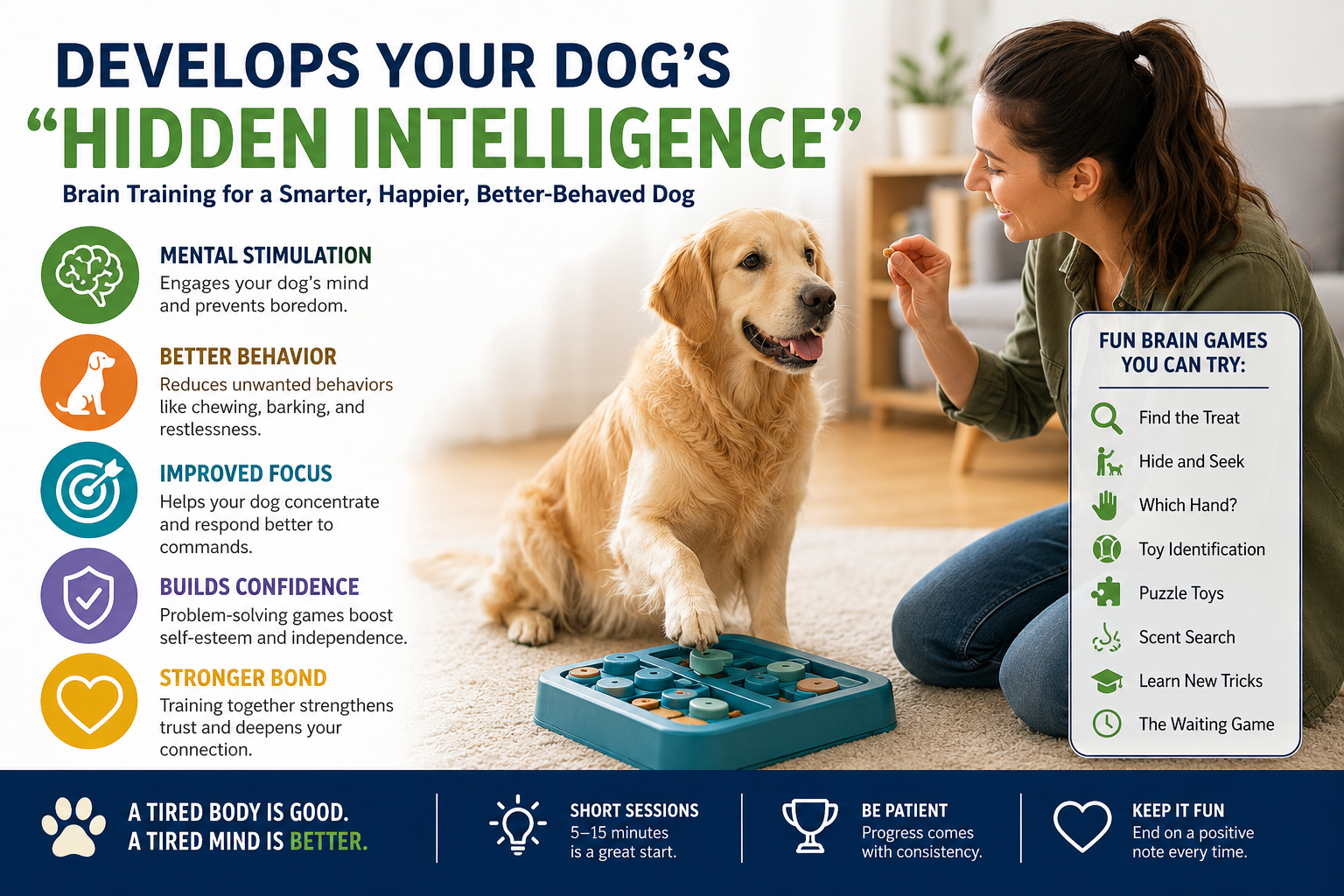
The phrase “Develops your Dog’s ‘Hidden Intelligence’” is closely associated with the concept of Brain Training for Dogs, a training approach popularized online by professional dog trainer Adrienne Farricelli. The program promotes mental exercises, structured training, and problem-solving activities designed to encourage dogs to use their natural learning abilities.
But what does “hidden intelligence” really mean? Can brain games actually make a dog smarter? And can mental training help with unwanted behaviors?
The answer is more interesting than a simple yes or no.
Dogs have impressive abilities to learn, remember, discriminate between cues, solve certain problems, and respond to their environment. With the right training, owners can give these abilities more opportunities to develop.
What Is a Dog’s “Hidden Intelligence”?
The term “hidden intelligence” is best understood as a simple way of describing a dog’s natural capacity for learning, problem-solving, attention, memory, and adapting to new situations.
It does not mean that every dog has a secret level of intelligence that can suddenly be unlocked.
Instead, dogs have different skills and strengths. One dog may be excellent at finding scents. Another may quickly learn tricks. A third may be particularly good at reading human gestures.
Brain training gives dogs opportunities to use these abilities.
Some examples of canine intelligence include:
- Learning new commands
- Remembering previously learned behaviors
- Finding hidden objects
- Following scent trails
- Solving simple food puzzles
- Recognizing familiar words
- Controlling impulses
- Responding to human gestures
- Adapting to new situations
- Learning from consequences
This is why effective dog training is not simply about making a dog obey.
It is also about teaching the dog how to learn.
What Is Brain Training for Dogs?
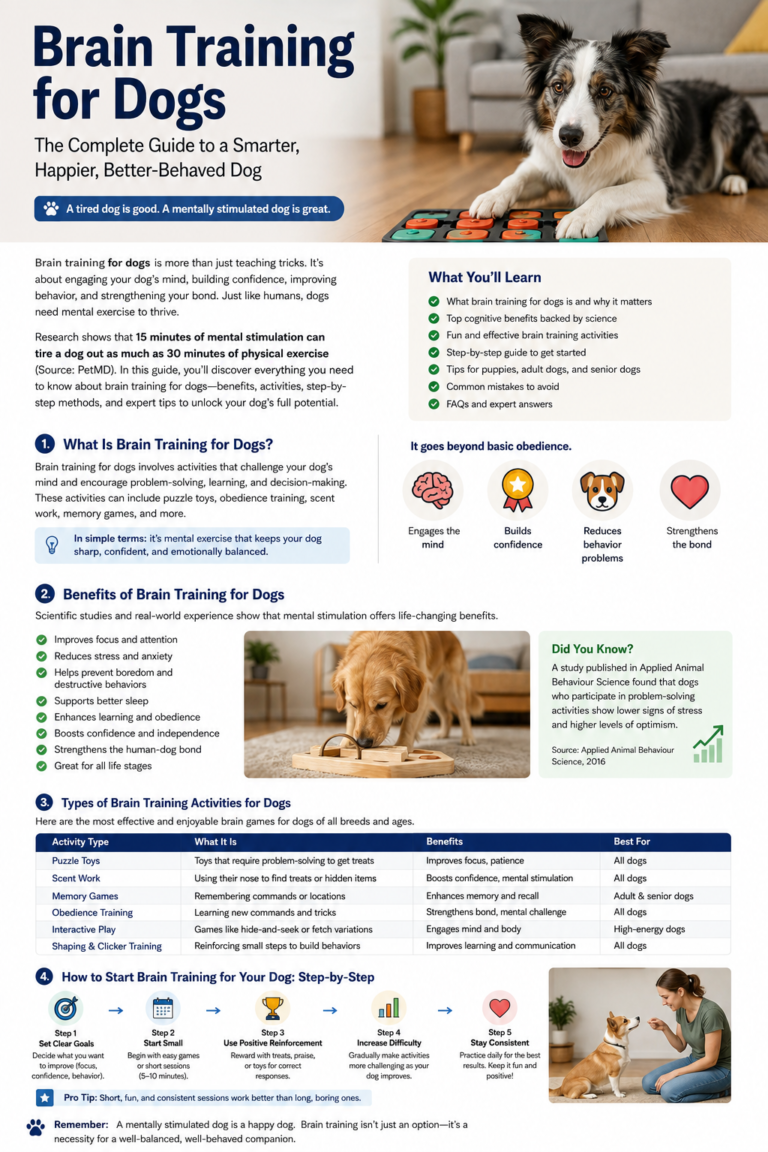
Brain training for dogs is a combination of training exercises, enrichment activities, games, puzzles, and problem-solving tasks that encourage a dog to think and learn.
Traditional obedience training might teach:
Sit → Stay → Come → Down
Brain training can take those basic skills further.
For example, you might teach your dog to:
- Find a specific toy.
- Touch an object with its nose.
- Choose between two objects.
- Search for hidden treats.
- Wait before taking food.
- Follow a scent.
- Navigate a simple obstacle.
- Learn a new trick.
The goal is not to overwhelm the dog.
The goal is to provide an appropriate mental challenge.
The American Veterinary Society of Animal Behavior recommends reward-based training methods for dog training and behavior modification and advises against aversive techniques.
How Mental Stimulation Helps Dogs
Dogs need more than physical exercise.
A daily walk is important, but walking alone may not satisfy every dog’s need for exploration and learning.
Mental enrichment can involve:
- Smelling new scents
- Learning new behaviors
- Searching for food
- Solving puzzles
- Exploring safe environments
- Playing interactive games
- Practicing obedience
- Learning tricks
Imagine two dogs.
Dog A goes outside, walks the same route, returns home, eats, and sleeps.
Dog B goes for a walk, gets opportunities to sniff, practices a few commands, searches for hidden treats, plays a puzzle game, and learns a new trick.
Both dogs received physical activity.
But Dog B also received more opportunities for mental engagement.
That difference is one reason enrichment is an important part of modern dog care.
Can Brain Training Really Make a Dog Smarter?
This is one of the most common questions surrounding the idea of a dog’s hidden intelligence.
The safest answer is:
Brain training can improve learned skills and provide valuable cognitive enrichment, but it should not be presented as a guaranteed way to increase a dog’s general intelligence.
A dog can become better at a particular task through practice.
For example, after repeated scent games, your dog may become much better at finding hidden food.
After repeated impulse-control exercises, your dog may become better at waiting.
After repeated recall training, your dog may respond more reliably to its name or recall cue.
These are meaningful improvements.
However, becoming better at one task does not automatically mean that every aspect of cognition has improved.
Think of brain training as skill development.
The objective is to help your dog:
- Learn
- Practice
- Explore
- Focus
- Make appropriate choices
- Build confidence
- Communicate with you
That is a much more realistic and useful goal than trying to create a “genius dog.”
10 Brain Training Games You Can Try at Home
One of the best things about dog brain training is that you don’t need a complicated setup.
You can begin with simple activities using treats, toys, cardboard boxes, cups, and everyday household objects.
1. Find the Treat
This is an easy scent game.
Start by placing a treat somewhere your dog can see.
Say “Find it.”
Allow your dog to approach the treat.
Once your dog understands the game, make the hiding place slightly harder.
Eventually, you can hide treats in different safe areas around a room.
2. Which Hand?
Place a small treat in one hand.
Close both hands.
Let your dog investigate.
When your dog indicates the correct hand, reward them.
This simple activity encourages observation and choice-making.
3. Hide and Seek
Ask your dog to stay.
Walk to another easy-to-find location.
Call your dog.
When your dog finds you, reward them.
As your dog improves, gradually make the hiding location more difficult.
4. Toy Identification
Put two familiar toys on the floor.
Name one toy.
Encourage your dog to approach it.
Reward the correct response.
With practice, you can introduce additional toys.
5. Simple Food Puzzle
Place treats inside a safe puzzle toy.
Let your dog investigate how to access the food.
Don’t immediately help unless your dog becomes frustrated.
The objective is to encourage exploration and problem-solving.
6. Target Training
Hold your hand close to your dog’s nose.
When your dog touches it, reward them.
Repeat until your dog deliberately touches your hand.
Target training can later become a foundation for more advanced behaviors.
7. The Waiting Game
Ask your dog to wait.
Place a treat nearby.
Wait for one or two seconds.
Release the dog and allow them to take it.
Gradually increase the waiting period.
This is especially useful for developing impulse control.
8. Learn a New Trick
Try teaching:
- Spin
- Shake
- Touch
- Back up
- Bow
- Go to bed
- Put a toy away
Learning a new behavior gives your dog a new mental task.
9. Scent Search
Hide several small food rewards around a safe room.
Encourage your dog to search.
Let your dog use its nose instead of guiding it toward every reward.
10. Mini Obstacle Course
Create a simple course using safe objects.
Your dog might:
- Walk around a chair.
- Touch your hand.
- Walk onto a mat.
- Sit.
- Walk through a doorway.
- Receive a reward.
Never force a dog through an obstacle.
The activity should remain safe and enjoyable.
How to Start Brain Training With Your Dog
If your dog has never done mental exercises before, start small.
Step 1: Choose one easy activity
Don’t introduce five new games at once.
Choose one.
Step 2: Use a valuable reward
Food is common, but it isn’t the only option.
Some dogs work harder for:
- Toys
- Play
- Praise
- Petting
- Access to sniffing
- Going outside
The best reward depends on the individual dog.
Interestingly, research published in Animal Cognition in 2026 examined whether Indian free-ranging dogs preferred food or petting as rewards during interactions, highlighting that reward preferences can vary between dogs and circumstances.
Step 3: Reward quickly
Timing matters.
When your dog performs the behavior you want, reward as close to that behavior as possible.
Step 4: Increase difficulty slowly
Don’t jump from beginner to expert.
Instead:
Easy → Slightly harder → Moderate → Advanced
Step 5: Stop before your dog becomes frustrated
Training should feel like a game.
If your dog repeatedly fails, simplify the exercise.
Why Positive Reinforcement Matters
Positive reinforcement is one of the most important principles behind effective reward-based dog training.
In simple terms:
Dog performs desired behavior → dog receives something valuable → behavior becomes more likely to happen again.
For example:
Your dog sits.
You immediately provide a reward.
Your dog learns that sitting has a valuable consequence.
Over repeated practice, sitting may become easier and more reliable.
The American Veterinary Society of Animal Behavior states that reward-based training should be used for dog training and behavior modification and specifically advises against aversive methods.
Rewards don’t always mean treats
Depending on your dog, reinforcement may include:
- Food
- Praise
- Play
- Toys
- Attention
- Sniffing
- Access to something the dog wants
The important point is whether the consequence actually motivates the dog to repeat the behavior.
Can Brain Training Fix Bad Behavior?
This is where dog owners should be careful with exaggerated promises.
Brain training may help provide appropriate outlets for energy and teach useful alternative behaviors.
But it is not a universal cure for every behavior problem.
For example, a bored dog that chews furniture may benefit from additional enrichment.
But chewing can also be associated with:
- Anxiety
- Teething
- Stress
- Lack of management
- Habit
- Environmental factors
Similarly, barking may be caused by excitement, fear, territorial behavior, frustration, attention-seeking, or other factors.
Aggression and serious anxiety require more than a few puzzle games.
AVSAB notes that more serious concerns such as aggression, anxiety, and fear may require environmental management, behavior modification, and in some cases veterinary treatment or medication.
A better approach is:
- Identify the cause.
- Manage the environment.
- Prevent unwanted behavior when possible.
- Teach an alternative behavior.
- Reward desirable responses.
- Provide appropriate enrichment.
- Seek professional help when necessary.
Signs Your Dog Needs More Mental Stimulation
Every dog is different, but some behaviors may indicate that your dog needs more appropriate activity.
Possible signs include:
- Constant restlessness
- Destructive chewing
- Excessive attention-seeking
- Repetitive barking
- Difficulty settling
- Pacing around the home
- Quickly becoming bored with toys
- Excessive excitement
- Searching for activities independently
However, don’t automatically assume that boredom is the cause.
A sudden change in behavior should be discussed with a veterinarian because pain or illness can sometimes appear first as a behavior change.
Brain Training for Puppies
Puppies are naturally curious.
That makes early learning an excellent opportunity to build positive associations with training.
Start with simple exercises such as:
- Responding to their name
- Coming when called
- Sitting
- Touching your hand
- Following you
- Waiting briefly
- Finding treats
- Exploring safe environments
Keep sessions short.
A puppy does not need complicated puzzles.
The goal is to make learning enjoyable.
Brain Training for Adult Dogs
Adult dogs can handle more complex challenges.
Try combining several skills.
For example:
Find the toy → bring it to you → drop it → sit → receive reward.
This creates a small chain of behaviors.
You can also introduce:
- Advanced tricks
- Scent work
- Puzzle toys
- Target training
- Obedience exercises
- Recall games
- Impulse-control exercises
The more experienced your dog becomes, the more creative you can make the challenges.
Brain Training for Senior Dogs
Older dogs can continue learning.
However, training should be adapted to their physical and sensory abilities.
Choose activities that are:
- Low impact
- Easy to understand
- Comfortable
- Rewarding
- Appropriate for their mobility
Scent games can be particularly useful because they can provide mental engagement without requiring intense physical exercise.
If an older dog’s behavior changes suddenly, however, don’t assume it is simply aging or lack of stimulation. Speak with your veterinarian.
How Long Should Dog Brain Training Last?
There is no universal training duration that works for every dog.
Instead, focus on the dog’s behavior.
A practical starting point is several short sessions throughout the day rather than one long session.
For example:
Morning: 5 minutes of obedience
Afternoon: 5 minutes of scent work
Evening: 5 minutes of trick training
That’s only 15 minutes of structured mental work.
You can adjust the routine based on your dog’s age, health, motivation, and attention.
Remember:
More training isn’t always better.
If your dog becomes frustrated or loses interest, make the task easier or take a break.
Common Brain Training Mistakes
Making the challenge too hard
If your dog cannot succeed, the exercise needs to be simplified.
Training for too long
Long sessions can reduce engagement.
Changing the rules
Be consistent about what behavior earns a reward.
Using punishment for mistakes
Punishment can create stress and does not teach the dog what behavior you actually want.
Ignoring individual preferences
One dog may love food puzzles.
Another may prefer scent work.
Another may want to play.
Expecting instant results
Learning requires repetition.
Treating every behavior problem as boredom
Serious behavior problems can have complex causes.
A Simple 15-Minute Brain Training Routine
Here is a simple routine for beginners.
| Time | Activity | Main Skill |
|---|---|---|
| 3 minutes | Name game | Attention |
| 3 minutes | Sit/stay | Impulse control |
| 3 minutes | Find the treat | Scent/problem-solving |
| 3 minutes | New trick | Learning |
| 3 minutes | Calm behavior | Self-control |
You can repeat this routine several times a week and change the activities to keep things interesting.
How to Know If Your Dog Is Improving
Don’t judge success only by how quickly your dog learns tricks.
Look for practical changes.
Your dog may:
- Pay attention longer.
- Respond faster to familiar cues.
- Try new tasks more willingly.
- Recover from small mistakes more easily.
- Show greater confidence.
- Follow instructions around mild distractions.
- Become more engaged with you.
- Settle more easily after appropriate activity.
Keep a simple training record.
Write down:
Date → Activity → Difficulty → Result → Next Goal
This makes progress easier to see.
Is “Hidden Intelligence” Really the Right Goal?
Perhaps the most useful way to think about this phrase is to move away from the idea of creating a “super-smart” dog.
Your goal should be to develop your dog’s existing abilities.
Every dog has different strengths.
Some dogs are excellent scent detectives.
Some are fast learners.
Some are highly motivated by food.
Some love toys.
Some enjoy working with people.
Instead of comparing your dog with another dog, discover what motivates your own companion.
That is where brain training becomes powerful.
Final Thoughts
Develops your Dog’s “Hidden Intelligence” is an appealing phrase, but the real value behind the concept is much more practical.
Dogs need opportunities to learn, explore, solve appropriate problems, and interact with their environment.
Brain games, scent work, puzzle toys, obedience training, trick training, and positive reinforcement can turn ordinary moments into learning opportunities.
The goal isn’t to transform your dog overnight.
It is to help your dog become more engaged, confident, responsive, and capable of learning.
Start with one simple exercise.
Reward the behavior you want.
Increase difficulty gradually.
Keep sessions enjoyable.
And remember that serious behavior problems should not be treated as simple “intelligence” issues. When fear, aggression, anxiety, or sudden behavior changes are involved, professional guidance may be necessary.
The best brain training program is ultimately one that helps both ends of the leash learn better communication.
When your dog learns something new, you learn something too—and that shared learning experience can become one of the strongest parts of your relationship.